
Contents
So, you’ve decided to take the plunge and buy a double bass. Congratulations, you’re now a member of a small, slightly eccentric, but wonderfully passionate group of musicians who, for some inexplicable reason, fell in love with an instrument that takes up the most room in every orchestra pit, every jazz club, and every car boot in history. Before you part with your hard-earned cash, let’s get a few things straight. Buying a double bass isn’t quite like buying a guitar or a violin. It’s a big decision, to say the least.
What Exactly Are You Buying?
The double bass is also known as the upright bass, string bass, or contrabass. It is the largest and lowest-pitched of all the instruments in the bowed-string family and shares ancestry with the viol family. It has four strings tuned to E-A-D-G, one octave lower than a cello, and a deep, resonant sound that has captivated both orchestral and jazz musicians. With a multitude of names and sizes, this gentle giant plays a crucial role in shaping the sound of music across genres and cultures.
How to Choose Double Bass Size?
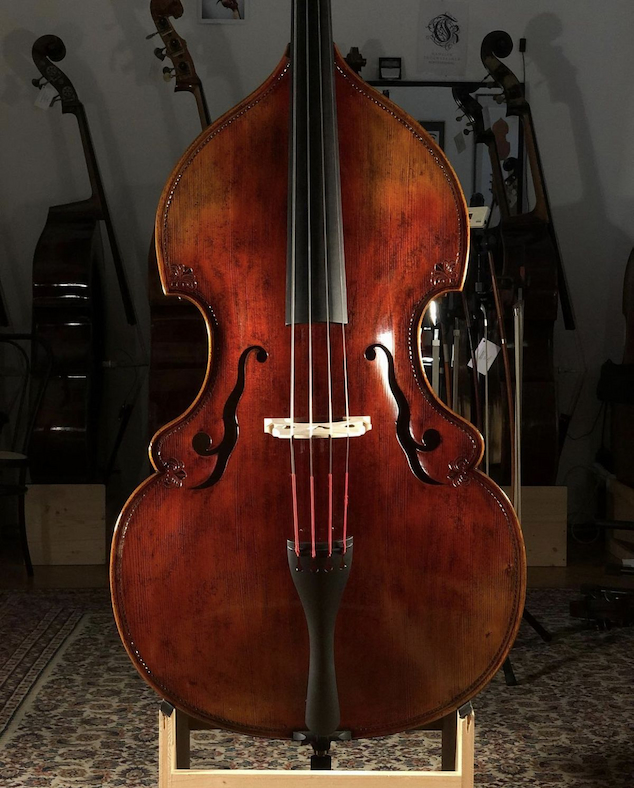
Unlike most other instruments, you can find a bass double bass in a variety of sizes, and getting this right is vital. The typical size for adults is 3/4, which, paradoxically, is the standard size for most double bassists. There are 4/4 full-sized double basses, but these are huge and really only needed for people with large hands or those who play in certain orchestras. If you’re buying a double bass for a child, there are half and quarter sizes available.
The easiest method for determining your size? Stand next to one. If a double bass is stood vertically on its endpin, then the nut, which is the small ridge on the top of the strings, should be level with your eye, or somewhere in between your eye and the top of your head. If, on the other hand, it towers over you like a redwood, you should look for a smaller size, and if it looks like a ukulele, go for a larger one.
Carved, Hybrid, or Laminate?
Laminate double basses are made from pressed-wood layers, kind of like plywood but refined. They are strong, humidity-resistant, and much less expensive. As a novice, a good laminate bass is the way to go.
Carved basses are made from solid wood, crafted by hand by a luthier. They offer superior tone with deep resonance that opens up with time. They are also sensitive to temperature and humidity, as well as significantly more expensive. A high-quality carved bass is for players who are serious about music.
Hybrid basses are a compromise: they have a carved spruce top, but laminate back and sides. This gives a step up in sound quality over a completely laminate instrument, but still remains in a price range below a completely carved instrument. If you’re an intermediate player looking to upgrade from a beginner instrument, this will probably be in your price range.
For a first-time player, a good quality laminate in the medium price range is a good place to start. Don’t buy a cheap instrument with no brand name available on the internet – these are poorly constructed, poorly set up, and will actually hinder your progress as a player.
The Setup: Often Overlooked, Always Important
One thing many beginners may not know is that even a decent upright bass can play terribly if it’s not set up properly. “Setup” means the adjustments done to the instrument by the luthier, including the string height (action), nut slots, position of the soundpost, and the state of the fingerboard.
High action means the strings are far away from the fingerboard, making it tiring to play the instrument. It can even cause injury if done for a long period. A well-set-up instrument is a joy to play. If you are purchasing from a shop, it is best to ask if the setup is included in the price. When purchasing second-hand, set aside extra budget for a luthier to inspect and adjust it. It is money well spent.
Bow or Pizzicato? Arco Style Matters
The bowing styles of double bass players can vary. French bowing has an overhand hold, which is lighter in weight. German bowing has an underhand hold, a larger frog, and is often preferred for its power. Neither is superior to the other. It is simply a matter of personal choice and your teacher’s guidance. If you are a student, it is better to ask your teacher for guidance before purchasing a bow. A beginner’s double bass outfit usually comes equipped with a brazilwood bow.
New vs. Second-Hand
The second-hand market for double basses is worth investigating. Due to their size, double basses are less impulse-buy items than guitars, which means there are many good second-hand ones available at reasonable prices. Again, try to play any second-hand instrument before buying, and if possible, bring a knowledgeable friend with you.
Final Note: Trust Your Ears and Your Body
The most important thing to remember is that a double bass needs to feel right in your hands and sound right to your ears. Every bass double bass has its own unique personality – some are dark and rich, some are bright and punchy. There is no such thing as a universally “best” first double bass; there is simply the right one for you.
Take your time, do your research, and ask as many questions as you like in the store. The double bass community is famous for its friendliness – after all, there’s always room for one more at the back of the orchestra.





Comments are closed.