
Contents
There are hundreds of boating accessories that will definitely improve your time spent on the water. These can be added to both new or old boats, and watercraft of essentially any size. Some will better performance and handling while others are geared to increasing safety and navigation. Fishermen are also catered to a wide selection of gear when going for the ultimate catch.
But if you’re after a little more comfort, and look for a little more shade on a hot summer’s day, why not consider getting a boat bimini top. This will also provide protection from stronger gusts, and some refuge during heavy downpours when the weather gets rough. And if your boat already came with one, but hasn’t quite stood the test of time, there’s a range of bimini tops with all the required kit for differently sized boats. All you need is a tape measure to get the right dimensions.
Bimini Tops vs Canopies – What’s the difference?
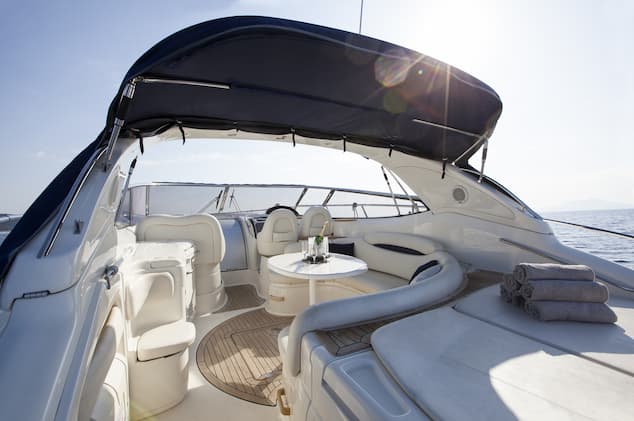
There’s confusion between boat biminis and canopies, as the two terms are used interchangeably. A bimini top is an open-front boat top typically made of polyester or canvas (though other fabrics are available) and supported by a metal frame. When it’s not needed, it can be collapsed and removed from the boat. A canopy, or spray dodger, is a protective cover that lines the boat entrance and part of the cockpit, and usually has vinyl windows. The latter is mostly found on yachts, so it’s also called yacht dodger.
What Goes Into a Bimini Top?
There are four basic ingredients to every bimini, though in different quantities and dimensions. First, there are mounting brackets that fit into the boat gunwales or rails and hold the bimini firmly fixed to the boat. Next are the bows or frames that form the skeleton of the bimini top. These are metal tubes attached to mounting brackets that slide into openings in the fabric, or the top proper. Lastly, there are tie-down straps that open and close the top as needed and add support when the boat is at speed.
The majority of bimini tops consist of three bows, as this is the recommended size for most recreational boats. Smaller variants will have two bows and are good for smaller fishing boats and inflatables. Where there is the need to cover a larger area, tops are often optioned with four main bows, and this is often the case with pontoons and deck boats.
Bows are often made of treated aluminium, as this is lightweight, strong, and lasts well against corrosion and sea spray. Larger and heavier tops may also have stainless steel bows to support the additional weight and minimise flexing. Mounting brackets and fittings are also quality metal offerings in larger tops, or simpler nylon offerings suitable for smaller vessels. Variations here are plenty, so you can get the right fit for your type of boat.
The last (and possibly the most important) thing to consider is the fabric. Polyester blends are the most common choice for most boaters, and the thicker the materials, such as 600D as opposed to 300D polyester, the longer they will last. Materials face the detrimental effects of UV rays and high heat, but also need to be fade and mould resistant to keep their shine.
Another factor is water and corrosion resistance with seal salt not particularly friendly to any type of fabric. Canvas is the more traditional choice but falls short in all critical areas when compared to polyester, especially that which has been treated with PU coatings. Get a top that is easy to clean, comes in the colour you like, and preferably with a lengthy warranty.
Sizing Your Bimini Top
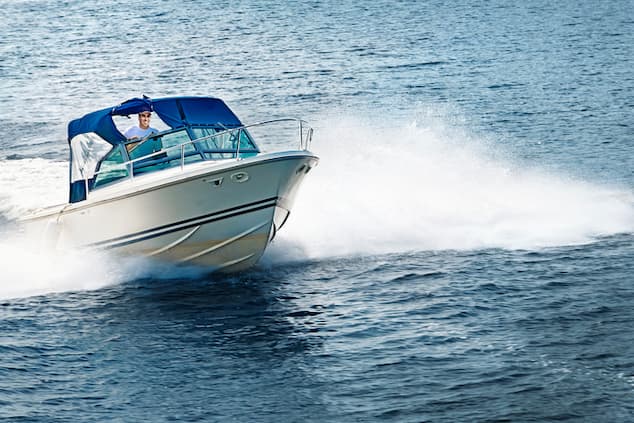
The top should be the right size for the part of the boat you want to be covered. This means lengths will vary as will the bow number. Smaller two bow tops cover up to 1.5 metres, three bow tops average out at 1.8 to 2 metres, and four bow tops go on to 2.5 metres or more. Lengths will also determine the position of the mounting brackets along the boat, and these are placed at half-length.
Widths are generally determined by the overall width of the area where the top will be. This is often the widest part of the boat. To get more coverage, you can also opt for brackets and fittings that swivel or are attached to the outside of the gunwales.
Heights should usually be a few inches more than your usual sitting position in smaller boats or your standing position on something bigger. Tops that are too high will offer less shade and can be unstable at higher speeds. Every bimini boat top offers some degree of flexibility in mounting so you should get the right fit. Just remember to take the basic measurements first.
Cleaning and Maintenance
A boat top needs just a few minutes of attention to be kept in the best condition. After every outing, a simple hosing down will remove most accumulated sea salt and dirt. Any remaining salt, dirt, or debris can easily be removed with a few strokes of a soft bristle brush. The top is left to thoroughly dry out so as to avoid mould buildup.
The top should also be waterproofed if you want it to last. As a precaution check that waterproofing solvents are compatible with the fabrics. The metallic parts, especially the aluminium bows should last, but to keep them to a glistening shine and remove any built-up oil, grime, or rust pockets, use an aluminium cleaner (based around hydrofluoric acid dissolved in water) and hose off with a pressure cleaner.



Comments are closed.