
Contents

Beacons and visual signals are irreplaceable when it comes to navigating through our daily lives. From the polite hot surface reminder lights on stovetops, to the blaring advance warning lights used in roadside construction, we rely on lights and signalling so much for advice and urgent information about conditions around us that we hardly even notice them.
And nowhere is this more true than in public spaces work, where we routinely depend on timely and accurate notifications from beacons and other visual devices – and sometimes multiple devices – to stay safe. People can become dangerously confused by written and audible instructions during a crisis, but emergency lighting in a hallway helps them to remain calm during an evacuation, while exit beacons lead them safely to their nearest point of egress.
Australian Standard AS/NZS 2293 covers the full scope of design, installation, and operation of emergency lighting devices and beacons in Australia; and fortunately, there’s a beacon manufacturer on the Australian market who understands the rules and the psychology behind them.
Beacons Save Lives
Although beacon systems can consist of multiple types of warning signals, they’re ordinarily organized around the most universal one: colour. The psychological aspects of colours, along with their intervals, intensities, and output modes are all crucial elements that Moflash beacons and visual devices use to make sure that there’s nothing ambiguous about the notifications they have to deliver. Colours provide the precise visual signalling that people are accustomed to responding to their entire lives; and when correctly utilized within an emergency notification system, the best-designed beacons also know how to utilize that instantaneous colour familiarity to save lives.
Beacons Operating Modes
Moflash makes a full range of IP66-rated beacons and coloured visual warning devices for all kinds of environments and situations that are easy to distinguish and interpret. They can even be configured to simultaneously deliver detailed private notification information for first responders and emergency crews while also providing the rapid, colour-recognizable messages the general public is relying on. There are 3 types of operating modes that beacons use to deliver their messaging.
- Static/continuous mode. Once initiated, a beacon remains continuously lit in this mode.
- Flashing mode. This mode requires that a lit source be continuously cycled off and on.
- Rotating mode. This mode pairs a revolving parabolic reflector with a static, continuously lit source.
The environment a beacon is being deployed in and the overall risk potential are the main considerations when deciding which operating mode will be the most effective for a specific application. However, a beacon’s light source is just as important as its mode. And because the operating modes, as well as the transmission frequency of the colours themselves, can be impacted by the source, being able to distinguish between them is a big part of understanding beacon design.
Beacon Light Sources
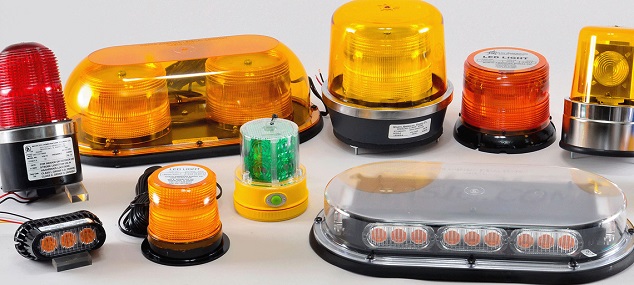
There are 3 main types of light sources used on modern beacons, and just like their operating modes, light sources also have to be suited to the application they’re being deployed to. Using short-life incandescent beacons on 100-meter-tall aviation warning towers would be a bad choice when long-lasting LEDs are available, which is why Moflash manufactures a complete array of beacons in an array of brightnesses and intensities that are suitable for any task.
LED Beacons
LED beacons use semiconductors that emit light when energized. With their extremely long lifespan of 25,000 hours and equally low power demands, they’re generally regarded as the most efficient beacon light source. They’re perfect for continuous mode and flashing mode beacons, and their ability to closely incorporate multiple colours into a single beacon enclosure also makes them ideal for advanced notifications systems.
Xenon (Strobe) Beacons
Xenon beacons utilize a discharge capacitor that flash-ignites a tube filled with xenon gas. These tubes reach maximum brightness almost instantly, making them the preferred light source for strobe-type beacons with 360° visibility, in both continuous and flashing operating modes. With an ordinary tube life of roughly 5 million flashes, or approximately 2,500 hours, xenon tubes are energy efficient, require very little power to initiate, and can be programmed to flash in intervals.
Incandescent Beacons
Although longer-live halogen-type bulbs have largely replaced tungsten-type bulbs as light sources, incandescent beacons still utilize classic wire filament elements that glow when heated. Incandescents only have a lifespan of around 2,000 and have higher power demand than LEDs or xenons, but their easy implementation and low acquisition costs make them excellently suited for long-duration lighting where maintenance wouldn’t be a problem.
Beacon Colours and Lenses
Beyond all the technical aspects of operating modes and lighting sources, the basics of visual signalling devices ultimately come down to which colours are used to deliver the messages. They need to be able to travel the maximum distance with the widest field of propagation, and Moflash beacons and multi-shaped lenses are designed to do just that in all of the standard signalling colours.
- Red. Indicates a condition that requires immediate action or attention.
- Amber. Indicates a condition that requires extreme caution, or the possibility of a condition diminishing to red.
- Green. Indicates that all conditions are normal and require no action.
- Blue. Condition or situation specific, with messaging that would normally be outlined within an organization’s emergency notification procedures.
- White (clear). Typically used for emergency outage lighting, but can also be condition specific.
Suffice it to say, without the ability to integrate high-intensity colours across the fullest spectrum of light sources and operating modes, it’s not possible to make a truly effective visual messaging system. Moflash beacons, however, do precisely that. And with the opportunity to combine their visual beacons with a full range of audio warning devices, keeping people notified and safe is all in a day’s work.

The Final Word
At the end of the day, regardless of whether they’re used only for routine machine operations in a factory, or are the main component used in hospital or commercial complex emergency notification systems, coloured visual devices provide the first, and most essential line of information for keeping people safe.
With a full range of models and power outputs to choose from, Moflash beacons provide the visual signalling that equates to decisive calls to action. And if you’re installing a new notification system or upgrading an existing one, you can rest assured that they have a beacon for every application.


Comments are closed.