
The successful placement of concrete depends on the mixing process, adequate transportation and of course, the usage of proper equipment. Mixing concrete is defined as a mixing process of the required ingredients for the production of a homogeneous concrete mixture. Consequently, the concrete can be mixed either by hand or with the help of concrete mixers, either stationary or portable concrete mixers.
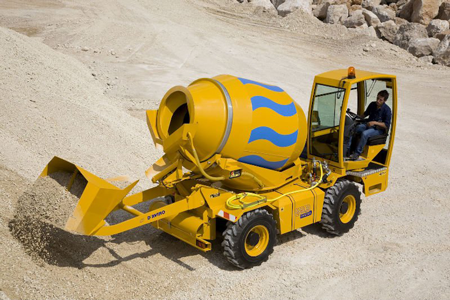
Stationary cement mixers are fixed in one place and cannot be moved. They are generally used for big constructing projects, where a continuous supply of concrete is required. On the other hand, portable concrete mixers are used for preparing and mixing small portions of concrete material. They are flexible and can be moved around the site easily. For easy transportation, the portable concrete mixers can be mounted on the back of a truck.
Concrete Batching
Regardless of the type of the cement mixer, a homogenous mixture cannot be created without the correct batching and mixing of all ingredients. Batching is the process of measuring and adding the ingredients into the stationary or portable concrete mixer bowl. The volume and the type of material, the mixing style and the strength or simply said the design specifications must be considered beforehand. The most important steps for proper batching and mixing are:
- quality assurance
- suitable arrangement of equipment and materials, and
- proper weighing of the materials.
Mixing Components
There are many mixing components that need to be considered to ensure high quality concrete mixture. Shape, location, the mixing angle, shape of the mixing chamber, horsepower and speed rotation must all be taken into account. It is important to know that each batch should always be mixed according to the design specifications.
Classification Of Mixers
Mixers can be classified as: drum mixers, continuous mixers and pan mixers. Each of these mixers can be additionally classified as continuous or batched, forced movement or free failing, and stationary or portable concrete mixer.
Mixing Time
Once you choose the proper mixer for your needs, it is necessary to determine the mixing time. Mixing time is the time needed to mix the concrete. Keep in mind that the mixing time is not standard for each batch, so you need to follow the specifications.
Transporting Concrete
The transportation of the concrete mixture is basically transferring concrete from the mixing to the construction location.
Choosing The Proper Concrete Transportation
There are several factors that need to be taken into account to ensure the concrete mixture does not change its structure during the transportation. The two main goals when transporting concrete from one place to another are to prevent segregation and to keep the mix workability. So, before moving the concrete, you need to organize the transportation process. As a general rule, 30 – 60 minutes of transportation are acceptable for small jobs. With stationary or portable concrete mixers, the concrete mixture must be discharged from a truck mixer within 2 hours, and in case you do not use any agitating transporting equipment, this time will be reduced to 1 hour. In order to prevent honeycombing, all delays must be avoided.
Selecting the right transportation mode is very important. Type and concrete mix ingredient, topography, size and type of construction, weather conditions, batch plant location and the cost are just some of the factors that need to be taken into account when choosing a mode of transportation. If wrong transportation mode is selected, the concrete may lose its strength and quality. Some of the preferable transportation modes are:
- Truck mixer
- Wheelbarrow
- Chute
- Bucket or steel skip
- Concrete pump
- Belt conveyor
- Pneumatic placer


Comments are closed.