
Household mould is more than an eyesore. It’s an uninvited tenant that thrives on your home’s moisture and messes with your air quality. Before you reach for harsh, chest-burning chemical bleaches that just mask the problem, take a breath. You don’t need a hazmat suit or toxic fumes to win this fight. Nature actually has its own heavy hitters. Here is your straightforward, chemical-free playbook to reclaim your walls and breathe easy again using ingredients already sitting in your pantry.
Clove Oil

Tackle stubborn household fungi with effective and natural clove oil for mould. This essential oil is extracted from the flower buds, leaves, and stems of the clove tree. It is widely recognised for its strong, spicy aroma and its natural antifungal properties. Unlike some cleaning products that simply remove visible stains, clove oil can help inhibit mould spores, reducing the likelihood of the growth returning quickly.
Mould thrives in damp, poorly ventilated areas such as bathrooms, laundries, kitchens, and around windows. When applied correctly, mould removal clove oil can penetrate porous surfaces and help address mould at its source. It is particularly useful for treating small patches of mould on walls, ceilings, grout, and other household surfaces.
To use clove oil for cleaning mould, mix approximately one-quarter teaspoon of the oil with one litre of water in a spray bottle. Shake the bottle thoroughly before use. Spray the solution directly onto the affected area until it is well covered. Allow the mixture to remain on the surface for several hours, or ideally overnight, so the oil has time to work on the mould spores.
After the waiting period, wipe the area with a damp cloth or sponge to remove the mould residue. For stubborn growth, a second application may be required. It is often recommended to leave a light residue of the clove oil solution on the surface after cleaning to help discourage future mould development.
Although clove oil for mould can be an effective cleaning solution by itself, it works best when combined with efforts to reduce excess moisture. Improving ventilation, repairing leaks, using exhaust fans, and controlling humidity levels can help prevent mould from returning.
Tea Tree Oil
Tea tree oil, steam-distilled from the leaves of the Australian Melaleuca alternifolia plant, is a natural, effective, broad-spectrum antifungal. While many household products only wipe out the visible mass, tea tree oil breaks through the lipid membrane of fungal cells, rendering the organism unviable. Because it is an exceptional deterrent, it is particularly useful for damp, high-risk zones like concrete basement walls, bathroom ceilings, and window tracks.
Because it is highly concentrated, a small bottle goes a long way. Combine 1 teaspoon of pure tea tree essential oil with 1 cup of water in a clean spray bottle. Shake vigorously to mix the oil and water. Mist the target area thoroughly. Do not rinse or wipe the solution away immediately. Allow it to sit on the surface to maximise its contact time with the spores. After several hours, use a damp cloth to wipe away the material.
Lightly re-spray the cleaned zone and let it air-dry completely. The residual oil acts as a shield that prevents new airborne spores from taking root.
White Vinegar
White vinegar is one of the most commonly used household products for dealing with mould. Its acidic nature helps break down mould growth and can reach beneath the surface on some porous materials. Because it is widely available and easy to apply, many homeowners use it to treat small mould problems in bathrooms, kitchens, laundry areas, and around windows.
To use white vinegar, pour it into a spray bottle without diluting it. Spray the affected area thoroughly and allow the vinegar to sit for at least an hour. This gives it time to interact with the mould and loosen its grip on the surface.
After waiting, wipe the area with a cloth or scrub it gently with a brush if needed. Rinse with water and dry the surface completely. Stubborn patches may require additional treatments.
Baking Soda
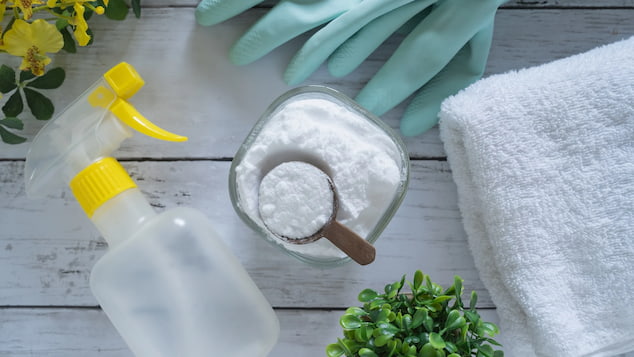
Baking soda is a powerful, scent-free weapon against household mould. Chemically known as sodium bicarbonate, this mild alkaline powder works on two fronts. First, its high pH creates an environment where mould cannot survive. Second, its natural abrasive texture allows you to physically scrub tough stains from porous surfaces like grout without scratching the material.
To use it, mix a 50/50 mixture of baking soda and water to form a thick paste. Smear it onto the mould, let it sit for 10 minutes, scrub vigorously with a brush, and wipe clean with warm water.
Hydrogen Peroxide
Hydrogen peroxide is a powerful antifungal, antiviral, and antibacterial agent that effectively eliminates mould. Unlike bleach, it breaks down into water and oxygen, leaving no chemical residue behind. It works by oxidation, essentially burning the organic structure of the mould and lifting stains from surfaces like drywall, tiles, and countertops.
To use it, pour standard 3% hydrogen peroxide directly into a spray bottle. Mist the mouldy area completely and let it sit for 10 minutes to fizz and work its way into the pores. Scrub the surface to remove debris, then wipe clean.





Comments are closed.