
Contents
When it comes to elevating eye comfort, sunglasses take the lead. Apart from being a fashionable accessory that provides comfort, they protect us from ultraviolet radiation too. And mind you, ultraviolet radiation isn’t only present when it’s sunny, it reaches our eyes even through clouds.
History
Inuits, the peoples of the Artic regions of Greenland, Canada and Alaska, had to dеal not only with lots of sunlight when working, but with the blinding reflection of the sun rays in the snow as well. That’s how, as far as we know, the first eye protection object was invented. The artefacts that support this come in the form of flattened walrus ivory eyewear with narrow slits that were used to reduce the exposure to the blinding lights.
From the Inuits’ walrus ivory goggles to today’s Versace lenses, corrective and tinted lenses and eyeglasses frames have gone through a lot of changes.

The earliest darkened eyeglasses were made from gemstones. There are indications that Roman emperor Nero wore something resembling eyeglasses made of polish emeralds. In China, court judges in the 12th century would wear eyeglasses with smoky quartz, not out of concern about how sun affects their eyes, but so that they would hide their facial expressions, to look impartial during interrogations.
In the 18th century, English optician James Ayscough started using tinted glasses believing that they would correct some vision problems. The first time tinted glasses were used to reduce brightness was in the 19th century, when doctors begun to prescribe them for people with syphilis, since light sensitivity is one of the common symptoms. The last breakthrough in what will become today’s sunglasses ware polarized lenses. This invention was made possible thanks to Scottish scientist, Ser David Brewster, who other than for discovering the kaleidoscope is famous for figuring out the polarised angle, also known as “Brewster’s angle”.

Styles
Sunglasses’ functions are to protect the eyes from the ultraviolet light, protect the skin around the eyes from the squinting, provide comfort and prevent headaches and nausea. But nowadays, we prefer it when functionality comes in a good-looking package. Since Hollywood stars in the early 20th century made sunglasses popular, they have become a necessary accessory for women and men alike, worn not just for their function but as an adorning or statement object as well.
Having so many options always makes choosing more difficult. You could spend hours and hours trying on different sunglasses until you forget your own a face. Fortunately, with such a huge production, many have thought about the right ways to choose sunglasses that will suit your face.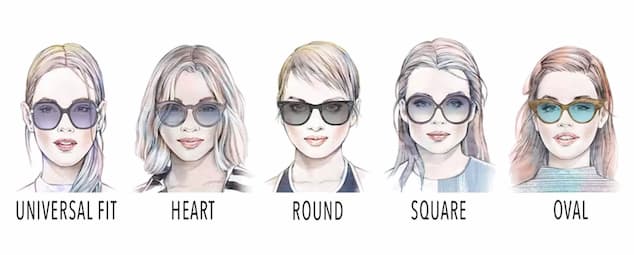
- For a round shaped face, avoid round frames, narrow frames and frames that cover your eyebrows. Sharp, angular lines, narrow bridges, glasses with grater wight than height will visually elongate your face, making it seem narrower.
- For an oval face, avoid huge or wide frames and sharp edges. Glasses with smooth lines, preferably as wide as your face or slightly wider, in line with the eyebrows, and reaching the cheek bones will look best on this face shape.
- For a heart shaped face avoid sharp, pointed edges, large frames, frames that cover your eyebrows and straight lines on top. Cat-eye style, aviator and glasses with rounded edges are ideal for this face shape.
- For a square shaped face, avoid square frames and sharp corners. Frames with oval curves, round or teardrop shaped will soften the sharpness of the face. Cat-eye glasses, oversized glasses, aviators and frames not wider than your cheekbones are also a good choice for this face shape.
- For a rectangular shaped face avoid small and narrow frames. Oversized glasses will make your face appear wider. Aviators and round glasses will also look great.
Maintenance
Finding the perfect sunglasses is like finding a treasure. And just like with treasure hunts, it’s a long process that can be costly. So, making them last you for a long time is up to you once you’ve done it. But no matter how careful you are with your sunglasses, lenses are not as easy to protect as the frames. Even with the latest technologies, they are prone to scratching, which not only makes it difficult to see through them, but can also damages the protection that they are supposed to give to your eyes.
Cleaning your lenses with a t-shirt, or anything other than microfiber also damages them. Wash your sunglasses gently with dish soap, using your fingers only, rinse them with warm water and dry them with microfiber cloth. Keep them in a hard case. Avoid leaving your sunglasses in the car, since the heat can delaminate your lenses, the lens coatings may degrade, and the frames may also get damaged. Handle them carefully: rather than by the arms, get used to putting them on by holding the bridge.
If your favourite expansive sunglasses got damaged anyways, you needn’t give up on them just yet… Keep in mind that good quality sunglasses can be readjusted, and their lenses can be replaced. Whether they are your pair of Ray Ban wayfarer sunglasses, your oversized Gucci sunnies, your Oakley polarized lenses, your quality Versace lenses, or any other designer sunglasses, there are professionals that can replace the scratched or broken lenses with the same if not better-quality lenses.


Comments are closed.